

Table of Contents
- What Counts as Subscription Box Filler
- How to Calculate Subscription Box Value for Money
- Understanding Subscription Box Cost Per Item
- Pros and Cons of Paying for Filler
- What to Do With Unwanted Subscription Box Items
- How to Cancel a Subscription Box That Isn't Worth It
- Making the Right Decision for Your Subscription
- Frequently Asked Questions
Last Updated: October 18, 2026
What Counts as Subscription Box Filler
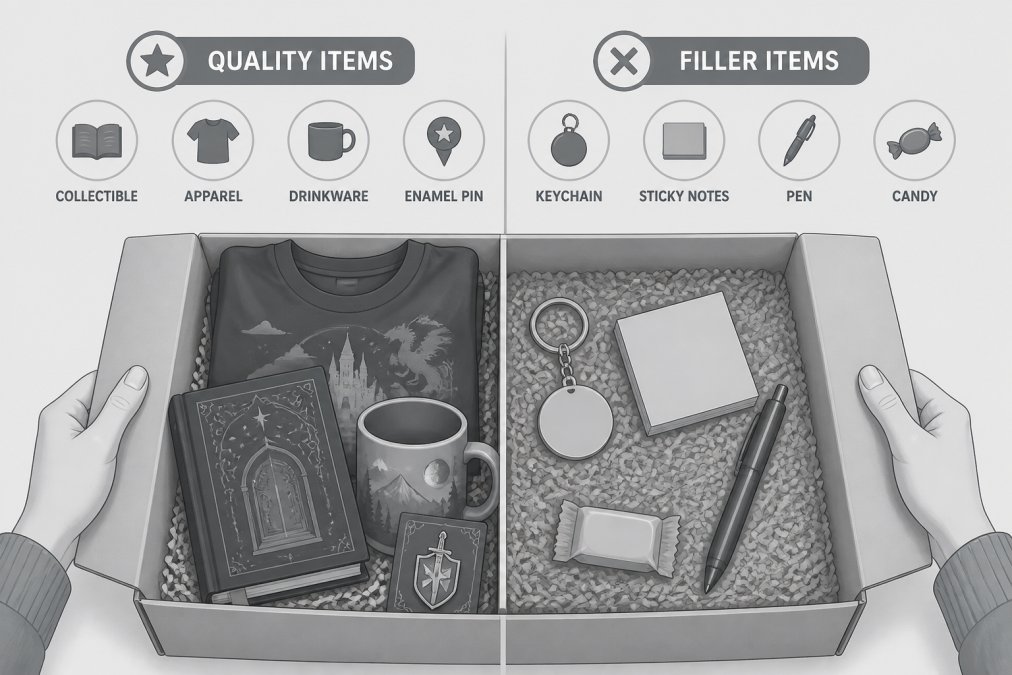
Subscription box filler is any item that adds stated retail value but little or no real value to you, the padding that lets a brand advertise a big number while keeping its own cost low.
The practical signs of filler
Use these tests on any item. Two or more matches usually means filler:
- Low utility. The item has no job in your life: a branded lanyard, logo pen, sticker sheet, or single-use sample packet you will never open.
- Generic rather than themed. A plain tote bag or blank notebook could go in any box from any brand, so it does not reflect the curation you are paying for.
- Duplicate. You already own it or a close equivalent. A sixth scented candle, a third water bottle, another makeup bag.
- Sample or travel size counted at full retail. A 0.3-ounce sample priced at the full-size retail price inflates stated value without giving you full-size use.
What filler is not
Not every low-cost item is filler. A $2 bookmark for a character you love can be genuine value because it fits the theme and you will use it, and a sample-size product can be worthwhile if it lets you test something you were already considering buying full-size. The test is not price, it is whether the item earns a place in your life after the unboxing high fades.
Why brands use filler
Filler exists because item count and stated retail value sell subscriptions. A box with eight items and a $60 printed value looks better in an ad than a four-item box with a $45 value, even if the latter delivers more of what you want. Filler is cheap to source and easy to price optimistically on the insert, the printed value is a marketing number, not a promise about your experience.
The difference between a worthwhile subscription and one full of filler comes down to how carefully items are selected and whether they align with what subscribers treasure.
Category-specific examples: useful item versus filler
The same rule plays out differently by box type:
- Beauty. Useful: a full-size moisturizer or cleanser in your skin type, or a deluxe sample of a product you were already going to buy. Filler: foil packets, tiny perfume vials, or a logo makeup bag.
- Food and snack. Useful: a full-size snack you will eat, or a themed pantry item. Filler: a single hard candy, a condiment packet, or a sample-size drink mix counted at full retail.
- Clothing and accessories. Useful: a wearable piece in your size and style, or a well-made themed accessory. Filler: one-size items that fit no one well, or a logo T-shirt in a generic cut.
- Hobby and craft. Useful: a consumable supply you will use up, or a tool that fills a real gap in your kit. Filler: a kit too small to complete a project, or a novelty unrelated to the hobby.
If a box's item list is heavy on the filler side of these pairings, the stated retail value is doing work your satisfaction will not confirm.
How to Calculate Subscription Box Value for Money
The stated retail value printed on a subscription box is often inflated. A box claiming $50 in retail value might contain items that cost the brand far less at wholesale, and some may be filler you will never use. To calculate genuine value, strip out filler first, then compare what is left against your true monthly cost.
A five-step method for calculating value after removing filler
- List every item and its stated retail value. Copy the insert or item list into a spreadsheet. Do not skip small items, filler hides there.
- Find a realistic street price for each item. Check the brand's site, a major retailer, and completed resale listings. Use the lowest price you could actually buy it for today. If an item is box-exclusive with no resale market, mark its realistic value as $0.
- Mark each item keep or filler. Keep only items you would buy at that street price with your own money, or that you will genuinely use within 30 days. Everything else is filler and gets removed from the total.
- Add up the keep total. This is your realistic value, the dollar amount of items you would actually pay for. The gap between it and the printed retail value is the filler premium you are paying.
- Divide the keep total by your true monthly cost. That is the subscription price plus separate shipping, taxes, and fees, divided by the months in your commitment. Three months at $90 plus $15 shipping means $35 a month, not $30.
A worked example
Suppose a box costs $40 per month with free shipping. The insert claims $70 in retail value across eight items. You price each item and mark keep or filler:
- Full-size skincare item, street price $18, keep.
- Themed enamel pin, street price $8, keep.
- Hardcover book in the box's theme, street price $15, keep.
- Sample-size serum, street price $3, filler.
- Logo tote bag, street price $4, filler.
Keep total: $41. True monthly cost: $40. The box is roughly break-even on realistic value, not the $70 the insert claims, but not a loss either. If the keep total had come in at $22, you would be paying $18 a month for filler.
The hidden costs that change the math
A simple item-value comparison misses costs that do not appear on the insert. Build these into your true monthly cost:
- Shipping. Some boxes charge shipping separately, and it can run $5 to $10 per month. A $30 box with $8 shipping is a $38 box.
- Commitment terms. Three-month, six-month, and annual prepay plans often lower the monthly price but lock your money in. Divide the prepaid total by the number of boxes to get the real per-box cost, and check whether the plan auto-renews at the higher month-to-month rate.
- Auto-renewal. Many subscriptions renew automatically unless you cancel before a deadline. Note the renewal date and the cancellation window the moment you subscribe.
- Cancellation fees or forfeited boxes. Some prepaid plans do not refund unused boxes if you cancel early. Read the cancellation policy before you pay, not after.
- Return shipping and restocking. If the box allows returns at all, check who pays return shipping and whether a restocking fee applies.
What to do with the filler number
Once you know your keep total and your true monthly cost, you have the filler premium. If your keep total exceeds your true monthly cost, the box delivers value even with some filler. If it falls below, the difference is what you pay for items you do not want, compare that against the cost of simply buying the keep items yourself.
The most honest calculation includes what you do with unwanted items. Donating filler is a loss; reselling on eBay or Facebook Marketplace might recover part of the value, but factor in your time. For low-value items, reselling is rarely worth the hassle.
Understanding Subscription Box Cost Per Item
Breaking down cost per item gives you another lens on whether subscription box filler is worth paying for.
A full-size luxury product might be worth $15 on its own, a sample-size product $2, and a box-specific novelty nothing at all.
Ask yourself: would you pay $5 for each item individually? If the answer is no for half the box, you're paying for filler.
Pros and Cons of Paying for Filler
The case for accepting some filler is straightforward: curated boxes introduce discovery. You try products you wouldn't have chosen yourself, and sometimes those surprises become favorites.
For fans, a themed box creates a monthly ritual of excitement.
The case against paying for filler is equally clear. You're subsidizing items you don't want with money you could spend on items you do.
Filler also creates waste.
There's also the psychological element.
What to Do With Unwanted Subscription Box Items
Once you've identified filler, your options are limited but real. The most common approach is donation, thrift stores, libraries, and community centers often accept gently used items, eliminating clutter without much effort.
Reselling is possible but requires realistic expectations.
Some people create gift bundles for friends and family.
The least productive option is keeping items in your home. Clutter accumulates and drawers fill up. Making a decision, donate, sell, or gift, is better than letting items pile up.
How to Cancel a Subscription Box That Isn't Worth It
If you've calculated the value and determined subscription box filler isn't worth your money, cancellation is straightforward but requires attention to detail.
Check your cancellation confirmation carefully. You need a confirmation number or email stating when your subscription ends.
Watch your payment method for the next billing date.
Some subscriptions offer pause options instead of full cancellation.
Before canceling completely, ask whether the service offers customization.
Making the Right Decision for Your Subscription
Deciding whether subscription box filler is worth it comes down to honest math and personal priorities.
Consider your alternatives.
For fans of fantasy stories and beloved characters, the emotional value of a themed box might justify some filler.
When a subscription prioritizes genuine curation over padding boxes with cheap filler, the value calculation changes.
The key is tracking what actually stays in your life after each box arrives.
Frequently Asked Questions
How can you tell whether subscription box items are filler?
Filler items are typically low-cost, generic products with minimal connection to the box's theme. Look for items priced under $3-5 at retail, mass-produced novelties, or duplicates of items from previous months. Check the original retail value of each item online, if several items have no verifiable retail price or appear only on discount sites, they're likely filler. Quality boxes balance 1-2 premium items with thoughtfully curated mid-range products; boxes heavy on cheap branded trinkets or sample sizes are padding the perceived value.
What is the best way to calculate subscription box value for money?
List every item in the box and research its actual retail value online. Remove items you won't use or already own, don't count them toward value. Add up the retail prices of items you genuinely want. Divide that total by the subscription price to find your cost per usable item. A worthwhile box typically delivers 40-60% of the stated retail value in items you'll actually use. Factor in recurring costs: if you cancel mid-year, check for early termination fees. Calculate annual cost, not just the monthly price, to see the full commitment.
Are subscription boxes cheaper than buying the items separately?
Not always. Subscription boxes rely on perceived value, the stated retail value is often inflated. You typically receive 30-50% of the advertised retail value in actual usable items, which means you're paying more per item than if you bought them individually at retail. However, if the box includes exclusive or limited-edition items not sold separately, or if you value the curation and discovery experience, the convenience factor may justify the premium. The key is comparing what you'd actually buy versus what arrives in the box.
What should you do with subscription box items you don't want?
Donate unused items to local charities, thrift stores, or community centers, this extends their life and helps others. Resell items in good condition on platforms like eBay, Facebook Marketplace, or Poshmark to recover some cost. Gift items to friends or family members who share your interests. If the box includes duplicate items or items you genuinely cannot use, contact the subscription service about swaps or replacements before discarding. Avoid throwing away items; reselling or donating reduces waste and can offset subscription costs.